One of the few things that majorities of Democrats and Republicans agree upon is that they don’t like free trade. Democrats may not like Donald Trump’s impulsive and sometimes nonsensical approach to tariff policy, but they share with Republicans a belief in using tariffs to protect American manufacturing jobs from foreign competition.
A few decades ago things were different. The U.S. joined various free trade regimes around the world; and there were free trade proponents in both parties who recognized that free trade makes goods less expensive for American consumers, leaving them more money to spend or invest in other ways. But free trade also puts pressure on American companies to keep prices low, and the growing ranks of populists in both parties attribute economic inequality and suffering to “globalization.” Free trade is one of those policies for which it is always difficult to muster political support because its benefits are widely distributed (to consumers) and its costs are concentrated among a smaller number of people whose economic well-being is threatened by competition from foreign goods.
But at this moment, this bipartisan consensus in favor of protectionism slows the transition to a cleaner energy mix. It gives anti-renewables Republicans like Donald Trump another tool to slow the adoption of clean energy, and it leads Democrats to want to use fiscally-expensive industrial policy to push the transition along.[1]. While getting to net zero carbon emissions will eventually require policy pushes, right now the transition would be happening more quickly if the U.S. did not impose import tariffs or regulatory barriers to entry aimed at particular technologies.
Most readers already know about the massive queues of mostly solar, battery, and wind projects waiting to connect to the grid – projects that investors want to build because those technologies are the most efficient option (even unsubsidized). But readers may also resist the idea of lowering tariffs on clean energy imports from countries like China, in part because they have an outdated picture in their mind’s eye of Chinese clean energy manufacturing companies.
An Eye-Opening Special Report
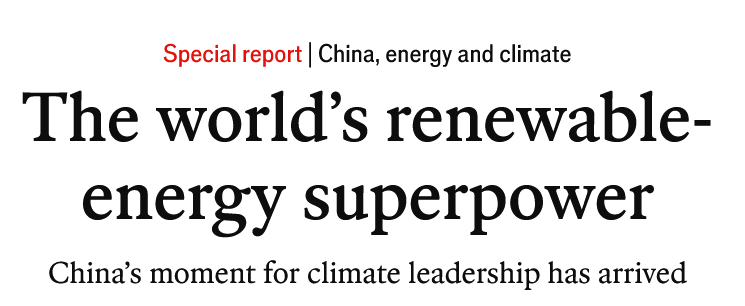
In November of last year, The Economist published one of their “special reports” on Chinese energy manufacturing: consisting of a summary article, and six associated articles diving more deeply into the specifics. (It is behind a paywall, but I am gifting the lead article here.) What emerges from that reporting is that Chinese clean energy tech is reliable and inexpensive. Most importantly, it is rapidly improving for reasons that other nations will not be able to match.[2]
Here are some of the key points, (Quotes are from the special report unless otherwise specified.)
1. Because of their massive domestic market, Chinese producers are able to realize economies of scale in production of renewable energy technology that American and European producers will never reach. For example, China produced more than 600GW of solar cells in each of the last two years, several times more than the rest of the world combined. And according to the International Energy Agency, China produced about two-thirds of the world’s EVs in 2024.
Scale means lower prices. According to the U.S. Energy Information Administration, the U.S. price of imported solar panels is about half that of U.S.-made panels, even with tariffs. Similarly, China’s leading EV manufacturer, BYD, offers good quality EVs for as little $10,000 in the Chinese market and $17,000 in foreign markets, prices U.S. makers would have difficulty matching without subsidies. (The U.S. has placed a 100% tariff on BYD EVs.) Not coincidentally, Chinese EV sales are growing rapidly in countries that do not impose tariffs on Chinese EVs, particularly in the developing world. And in Norway, which exempts EVs from certain vehicle fees, 90% of new car purchases are EVs, and Chinese makers are commanding a growing share of that market.
2. Where Chinese companies once lagged in innovation, they now lead. For example, Chinese producers have been recent innovation leaders in EV battery charging times and battery designs, and in offshore wind mega-turbine designs (see here and here). In 2024, 75% of global clean energy patent applications came from Chinese companies.
3. Yes, cheap labor is a part of the equation. Workers in poorer countries get paid less. From our perspective that is a competitive advantage against American workers; from the Chinese perspective, it is a one dimension of their country’s relative poverty. It is probably also true that clean energy manufacturing in OECD nations is less polluting than Chinese manufacturing. Much of Chinese clean energy manufacturing is powered by coal-fired power and its associated carbon, sulfur dioxide, deadly fine particle and other emissions. On the other hand, the special report notes that most observers believe that China’s carbon emissions are at or nearing their peak, thanks in part to the availability of better cheaper alternatives to coal. (See also here and here.)
4. Xi Jinping has dictated that clean tech – especially solar, batteries, and EVs — is a “pillar” of China’s “socialist modernization.” But subsidies and tariffs are no longer driving the industry. Rather, it is domestic demand and competition between Chinese firms, along with access to key minerals. In the words of the special report:
China is building and deploying renewable energy capacity on a scale that is hard to comprehend. This deployment is now central to the expansion of the electricity supply on which the Chinese economy depends … The innovation, economies of scale and cutthroat competition associated with this boom have seen the costs of solar panels, batteries and wind turbines plummet. As a result people in the global south, from which most carbon dioxide emissions come, are increasingly able to afford cheap electricity.
This makes possible a virtuous circle. The more other countries invest cost-effectively in fossil-fuel-free growth, the better it is for Chinese industry. The success of the world’s biggest economy is increasingly aligned with the world’s level of ambition in tackling the climate crisis. (emphasis added)
Being Smarter About Trade and the Energy Transition
What China has accomplished ought to shake up opponents and proponents of the energy transition alike. It challenges the belief by some on the right that absent strong U.S. climate policy the electric grid will always need gas-fired generation and gasoline-fueled cars. And it challenges the belief by some on the left that subsidies and tariffs can nurture a domestic solar panel or wind turbine manufacturing business to maturity and success. The special report implies that that will be difficult.
Remember, U.S. investors already prefer solar, wind, and battery electricity infrastructure over fossil-fueled electricity infrastructure. Given investor attitudes toward renewable energy and batteries in today’s high-tariff, high regulatory barriers-to-entry regime, imagine how much more of those resources would be developed in the U.S. if those policy barriers were lowered?
We can acknowledge the difficulty (futility?) of protecting the U.S. energy industry from increasingly inexpensive Chinese renewable energy and battery technology, and also recognize that there are still many, many jobs to be created in a complementary domestic clean energy industry. These might include jobs in (a) most of the geothermal and nuclear power value chain, (b) installation and operation of wind, solar, and battery installations, and (c) installation, and operation of transmission and distribution upgrades necessary to bring inexpensive clean energy to market.
Meanwhile, more and more American communities will bear the increasing costs of climate change: higher property insurance, mortgage, and electricity rates associated with more severe drought, floods and wildfire events, and higher taxes associated with public investment in infrastructure to mitigate those same harms, etc. If those costs become important enough to voters, that might counteract the political effects of the right wing media campaign against clean energy.
Political opposition to free trade is understandable, and some competition with China is in the national interest. Protectionist nationalism seems an appropriate response, for example, to China’s attempts to use technology sales to spy on the U.S., or the development and deployment of artificial intelligence, for example. But taxing or forgoing altogether the massive benefits of Chinese renewable energy, EV, and battery technology seems like an unnecessary own goal. Isn’t the better response to create a better economic transition policy and safety net for displaced workers?
Still, one must acknowledge that free trade is one of those policy positions that has become so politically unpopular that some experts now embrace it mostly in private, reasoning that advocating for it is futile. The same can be said for carbon taxes. But that doesn’t mean these ideas shouldn’t be discussed out loud. If elected GOP politicians will oppose all efforts to give the energy transition a policy push (as they are currently), perhaps the best near term strategy is to let the (worldwide) market move the transition forward until broader support for a policy push materializes. – David Spence
—————
[1] The Biden administration‘s efforts to hasten the transition centered on the Inflation Reduction Act, a set of tax subsidies designed to build and support a domestic clean, energy manufacturing sector (read: create clean energy jobs. Like most regulatory legislation passed by bare partisan majorities, it has been drastically weakened since. And because those tax subsidies reduce tax revenues, this approach increases deficits and national debt.
[2] Recently the good folks at the Breakthrough Institute, as is their wont, called out hyperbole among environmental activists who were puffing up China’s own environmental accomplishments. But as The Economist special report makes clear, just because China’s clean energy ambitions are export focused (rather than focused on its own environmental performance) doesn’t negate the value of those exports to the worldwide energy transition. And China’s clean energy export goals yield cost reductions that will ultimately have emissions-reducing effects in its own economy.