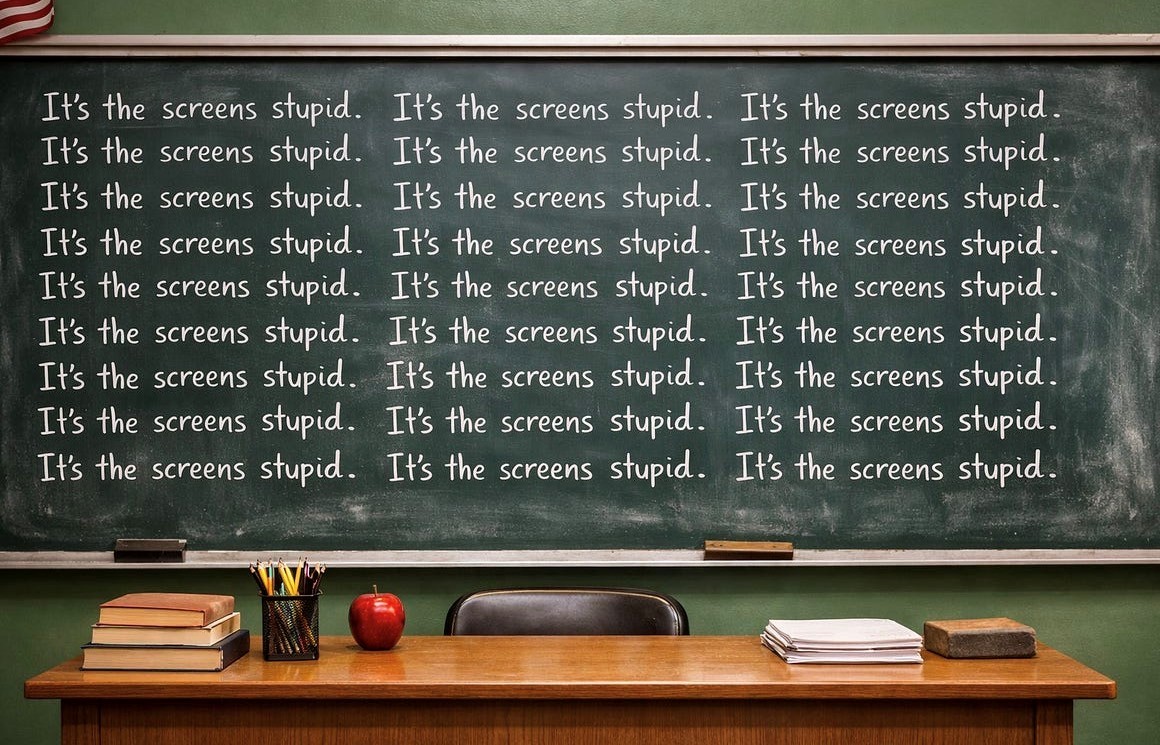
Goodbye cruel public opinion …
When David Brooks announced earlier this year that he would stop writing his column for the New York Times, he explained things this way:
When I came to The Times, I set out to promote a moderate conservative political philosophy informed by thinkers like Edmund Burke and Alexander Hamilton. I have been so fantastically successful in bringing people to my point of view that moderate Republicans are now the dominant force in American politics … I figure my work here is done.
I’m kidding.
Most academics can sympathize.
I began this blog 2 years ago to promote an understanding of our political dysfunction that I outline in my book — one that has lots of empirical support in academic research but tends to fly under the radar in many circles (including environmental legal scholarship). It points to modern ideological media and social media as a crucially important amplifier of misinformation, ideological extremism and partisan tribalism among the most partisan voters, who then exercise disproportionate influence over politicians by dominating primary elections.[1] And like David Brooks, I have been so fantastically successful in bringing people to my point of view that my work here is done.
I too am kidding.
I have to acknowledge that the book hasn’t had the impact that I hoped it would, at least so far.[2] But there are understandable reasons for this.
First, people don’t amend their political world views easily. Second, the book challenges deep-seated morality-based judgments of the climate coalition’s policy adversaries that many of my fellow left-leaning voters hold. The cartoonish corruption of the Trump Administration reinforces those views, however poorly they apply to energy politics generally. Third, we academics have our bubbles too, some of them methodological; it is difficult to keep track of everything happening in every discipline on a topic like energy transition politics. E.g., in my opinion, empirical political science does not get its due in a lot of legal scholarship. Fourth and finally, it may be that legal scholars just do not find that empirical work compelling enough to engage with it. They may see politics as beyond the domain of their policy analyses, even as faulty assumptions about politics form the basis of those analyses.
Meanwhile, I think that my efforts to apply the book’s model of energy politics on this blog have become a broken record. Broken records are annoying, so it is time to move on. On or about May 1, this blog will go dormant for an indefinite period.[3] Until then, the lawyer in me wants to make one last closing argument.
So, on the occasion of yet-another poll documenting the mutual contempt with which U.S. citizens now view one another, I want to use my remaining blog posts to make the case (with new data and sources!) for why we ought to be more curious and less judgmental about the players at the heart of energy and climate politics.
The “news” we see makes most people deeply skeptical of that proposition, but the data are on my side. Contempt for entire groups of adversaries is almost always misplaced. So, let’s start with Trump voters …
DATA: “Trump voter” is not the same thing as “MAGA voter”
One of the lessons students learn in the first year of law school is that some of the bad things that happen in life are nobody’s fault. First year courses in criminal law and torts include cases in which defendants prevail because the judge or jury is unconvinced that those defendants have violated the standards according to which we impose liability our fellow citizens — despite those defendants’ involvement in the bad things that happened. Indeed, these cases get to court in the first place because it is human instinct to cast blame when things go wrong.
So it is with energy and climate policy.
Politicians and advocates want us to misunderstand “the other side,” and they work actively to cultivate that misunderstanding. In modern social and ideological media they have the most powerful propaganda tool in history at their disposal. And unfortunately, we humans are prone to political misunderstanding anyway, according to the academic research:
Votes are observable, but voters’ reasoning is not. Given that voting decisions are multidimensional, it is a leap of logic to impute to a voter some specific belief based on their vote, but we make that leap nevertheless. … [M]any of the 74 million people who voted for Donald Trump in 2020 did not intend their vote as an endorsement of his venality or irresponsibility in office or of every policy decision he made. …
Yet another study concludes that people tend to infer (mistakenly) that the opposing candidate’s most extreme attributes “play[] an especially important role” in voters’ decision to support that candidate. These mistaken inferences create cycles of contempt. According to the authors, “When [we] infer that an entire voter base was singularly motivated by an especially extreme—and divisive—policy issue, perceptions of political polarization are likely to grow.” Unsurprisingly, lobbyists exploit these mistaken inferences, feeding popular perceptions of opposing party extremism. Online provocateurs know that provoking intemperate reactions from adversaries can accelerate that process.[4]
We have enough data on the views of Trump voters to know that they are not all (or even mostly) hard core MAGA believers. The Pew Research voter typology and the Yale Climate polling typology show us that heterogeneity. Pew Research places all voters in one of 8 ideological/philosophical categories, including some non-MAGA categories inhabited by Republicans, such as “stressed sideliners” and the “ambivalent right.” Indeed, those two categories represent about one third of the GOP coalition. The Yale poll confirms something similar within climate policy: i.e., that about one-third of climate policy opponents are far from firm in their anti-climate policy positions.
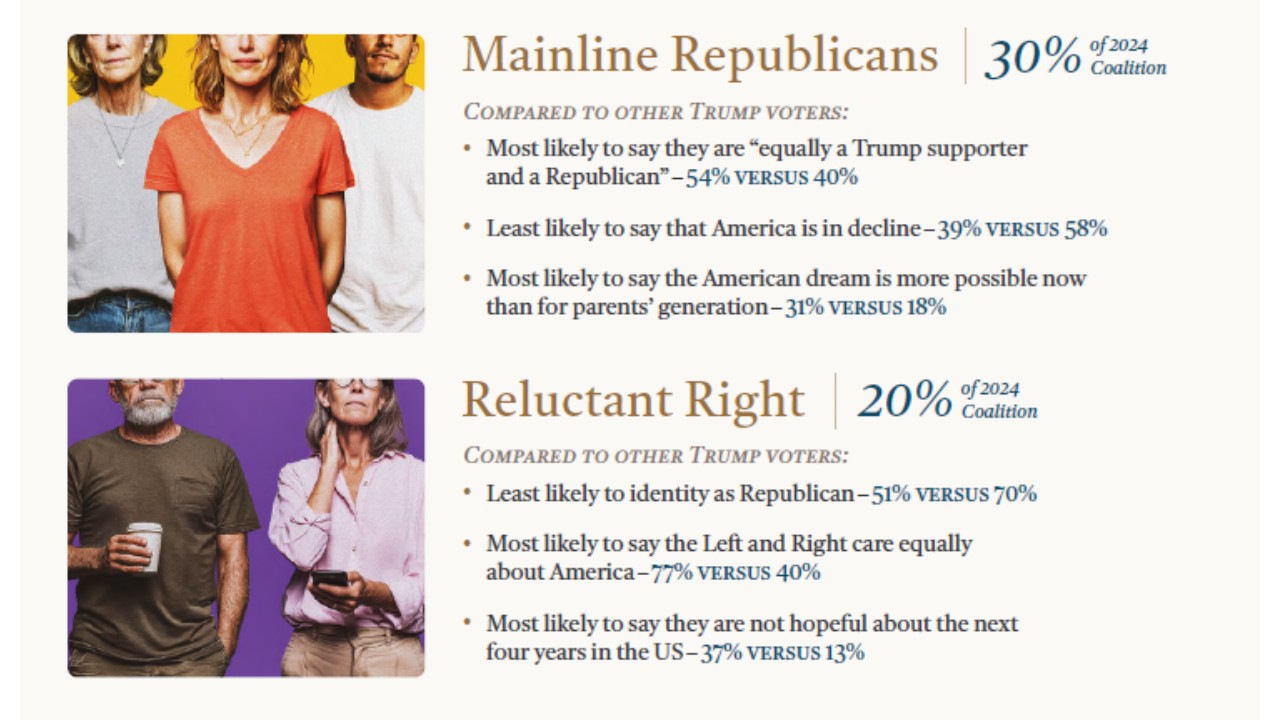
A more recent picture of Trump voters comes from the new report “Beyond MAGA,” polling by the NGO called More in Common. It classifies Trump voters into four categories: (1) Hardcore MAGA (29%), (2) Anti-Woke Conservatives (21%), (3) Mainline Republicans (30%), and (4) the Reluctant Right (20%), and offers a detailed breakdown of all four categories. It is worth careful study by anyone who wants to understand, or generalize about, Trump voters.
Deep dives into the Mainline Republicans and the Reluctant Right categories shows that both groups contain voters who are repelled by the anti-democratic philosophy of the MAGA core. These two groups are less inclined to hate or demonize Democrats, less comfortable with violating the law to achieve GOP ends, and less approving of most Trump policies than the average GOP voter. None of which is news to pollsters and political scientists, but it might surprise people whose picture of Trump voters comes from progressive video platforms full of “So and so HUMILIATES MAGA Idiot!” videos, or Jordan Klepper’s comic pieces from Trump rallies.
At the same time, the report shows why these two subsets of the Trump coalition voted for Trump in the first place. They generally support mass deportations (though not necessarily how the Trump team is approaching that task), and they oppose what they see as “wokism.” In the language of the report, these concerns “extend across demographic boundaries,” and command a majority of all four categories of Trump voters.
Trump 2.0 is alienating these persuadables, but the persuadables are outnumbered by the hardcore MAGA voters in primary elections. And GOP candidates know it. This is true not only in the 80% of congressional races that are safe for the majority party, but in competitive seats as well. Cook Political Report is tracking the content of 2026 political ads for candidates in the least safe/most competitive House districts (data behind paywall). Even there, candidates’ first priority is to trumpet their fealty to Trump and Trumpism (click on figure).
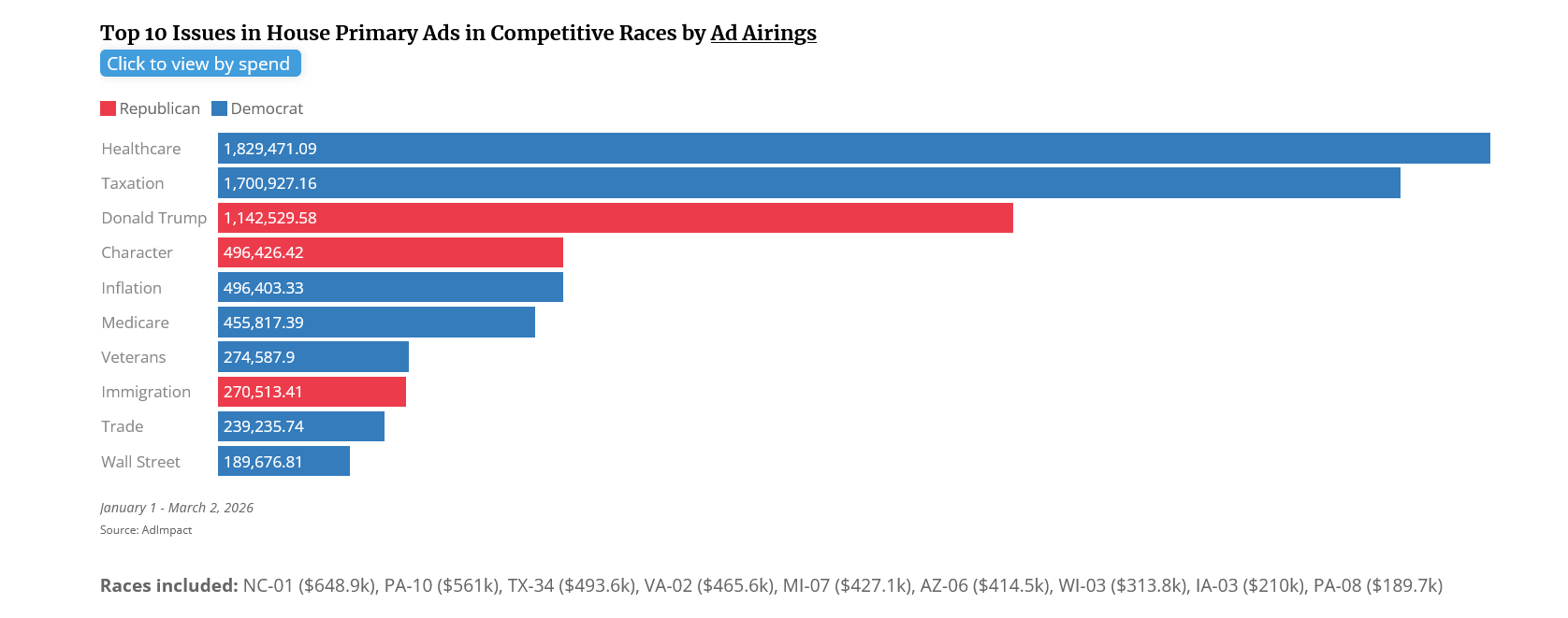
Apparently, the unpersuadables in the Trump coalition still dominate primary elections. The information sources they trust (inside their bubbles) tell them that Democrats will take their guns, threaten their cultural traditions, and steal elections, in part by bringing undocumented immigrants into the country to vote. They are angry, afraid, and they vote.
Politicians are generally very good at maximizing their chances of getting reelected. Even after a taste of Trump 2.0, GOP congressional candidates are still catering to the wishes of the MAGA faithful in order to win their primaries, irrespective of how other segments of the GOP electorate feel about the MAGA agenda.
Persuading the persuadables
But the persuadables represent an opportunity, one that online forces will push Democrats to squander.
Why? Because there is fear on the left too, and for good reason. But it breeds anger, extremism and the instinct to judge and reciprocate: to meet extremism with extremism, lawlessness with lawlessness, violence with violence, etc. (See e.g., this snapshot of a primary race in a blue House district.) These kinds of centrifugal forces make it instinctively harder to engage the persuadables with patience and empathy. Instead, we are more likely to do so as shown in this recent Saturday Night Live sketch, or to convince ourselves that there are other paths to durable progress that don’t require engaging Trump voters at all. (There aren’t.)
But there is no substitute for respectful, persistent engagement across partisan and ideological boundaries: the “deep canvassing” and “connect-bond-inspire,” and other approaches outlined in chapter 6 of Climate of Contempt. Encouragingly, some activist groups on the left are coming around to this idea; and this approach gets easier when we recognize the persuadables for the well-intentioned people that they are. If more and more of us can do that, there is hope. – David Spence
NEXT POST: Electric utilities in the mind’s eye
————————-
[1] This is a bottom-up explanation for our political dysfunction, one that explains why we don’t have the kind of climate and energy policy that majorities would want. (The introductory chapter of Climate of Contempt outlines the analysis, and is available for free here.) Partisan ideological polarization is not new; it has been growing since the 1980s. The declines in the competitiveness of congressional elections has been going on for even longer. Partisan hatred, however, is a 21st century phenomenon. More about that data here.
[2] Its sales were in the mid-triple digits in 2024 and 2025. I had hoped for more, perhaps unrealistically. More importantly, the book has not had a discernible influence on the way my peers in legal/policy academia discuss the political economy of energy regulation. (One legal scholar who is engaging with it is Lincoln Davies of the University of Utah School of Law.) The book was the subject of some very thoughtful book reviews, but most legal scholars continue to ignore the empirical literatures that I discuss in my book in favor of an “economic power drives policy outcomes” frame.
[3] If I revive this blog later, it will not be to discuss energy politics or my book. I am thinking of using it for book reviews on energy topics.
[4] Climate of Contempt, pp. 135-6 (citations omitted; emphasis added).