The 2024 election was an obvious setback for climate policy. But those results may also have had relatively little to do with energy and climate policy, and more to do with voter attitudes toward (what they perceived to be) Democrats’ cultural messaging.
One thing that seems to unite traditional conservatives and MAGA Republicans is their objection to the cultural critiques of the progressive left, particularly as they manifest on college campuses. Documentaries mocking progressive terminology surrounding gender and race have proven popular among young conservatives. Some pundits blame “wokism” for Kamala Harris’ defeat, and for Democrats’ loss of working class supporters. Whether or not that is accurate, Republicans of all stripes saw (and see) anti-wokism as a set of winning issues. Author Dan Gardner recently summarized the electoral risks of culture war issues for Democrats thoroughly here. (For it’s part, The Guardian both agrees and disagrees.)
Sometimes people invoke identity-based frameworks — or race-, sex-, and other demography-based explanations — in discussions of energy/climate politics and policy. For examples involving activists, see, e.g., here; among advocacy journalists, see, e.g., here and here. And in academic thinking it constitutes an established strain of scholarship.[1]
Critical Theory & Today’s Politics
Some progressive scholars characterize the climate status quo as the product of “colonialism” as a continuing problem that subsumes a smorgasbord of identity politics critiques and critiques of capitalism, including “neoliberalism, racial capitalism, development interventions, [and] economic growth models.” These ideas are relatives of “critical theory,” which has become a term of derision on the right. Indeed, several red states have banned its teaching in schools and DEI (diversity, equity and inclusion) programs on college campuses.
Academics and activists could and should discuss these ideas with more circumspection, humility, and precision — IF persuading others is the end goal.
When I was a Duke University graduate student in the 1990s, critical studies was fairly new, and sometimes went by other names like “deconstructivism” or “postmodernism.” Duke back then was one of the centers of academic conflict over postmodernism. Duke English professor Stanley Fish had become one of its leading lights (or lightning rods), and Duke political scientist James David Barber one of its leading opponents. Fish has since been eclipsed by other proponents of identity-based critical theory, and Barber died in 2004. But in the 1990s their feud was a bitter one that rippled across campus.[2]
Fish’s rhetorical approach back then focused on provocation more than engagement or persuasion. In his words, “the correct response to a vision or a morality that you despise is not to try and cure it [through persuasion] …. [W]hat you do in response to the speech of your enemy is not prescribe a medication for it, but attempt to stamp it out.”[3] For his part, Barber had founded the Duke chapter of the National Association of Scholars, which criticizes postmodernism and defends traditional “western liberal” scholarly values, including aspirations to objectivity, empiricism and the like. He openly opposed Fish on these issues.
For those of us who were among the noncombatants, it was an interesting and thought-provoking time. Many of us had to think a lot about how to reconcile conflicting intuitions about the fight, and we discussed those issues with each other.
On the one hand, scholars ought to be willing to investigate the origins of their most foundational and cherished beliefs — including norms and institutions we take for granted. We ought to recognize that objectivity can be an elusive aspiration, and that the unconscious biases of the numerical majority affect outcomes in a democracy. We ought not to assume that seemingly-neutral institutions formed under conditions of wealth or power inequality are in fact neutral or useful today. In a competitive world, competition isn’t fair if some competitors have been given a head start.
On the other hand, nor should we assume that existing institutions are necessarily outmoded or rigged; rather, the truth or falsity of that proposition ought to be determined or debated based on the evidence. The mere recognition that institutions are social constructs does not answer or resolve these questions. Nor does it shift the burden of proof in those inquiries.
Stanley Fish’s reluctance to engage opponents directly seemed unscholarly to many of us. He also used narrative frames and terminology that seemed to condemn behavior that wasn’t self-evidently blameworthy, without engaging the question of why he saw it as blameworthy.[4] But Fish’s approach is unscholarly only if you believe (as I do) in a liberal democratic model of truth seeking based on dialogue, fallibility, and open minded thinking. If instead, you see that model of truth-seeking as one of the liberal Democratic institutions by which the elites oppress the masses, then Stanley Fish’s approach may resonate.
So with that backdrop, a few thoughts on how to separate the wheat from the chaff when it comes to “colonialism” in energy and climate policy.
Migration, “Culture,” and “Colonialism”
For all of human history, humans have migrated — searching for resources, escaping persecution, evangelizing in service of their religions, seeking the glory of military conquest, etc. Migration exposed tribes and cultures to new ways of thinking and living; the groups involved retained some of what the other society brought to the interaction, and discarded the rest. That process was sometimes peaceful, sometimes violent, often fraught. But it also pushed innovation and technological progress.
Recent scholarly histories of these ancient encounters dispel the notion that there is a bright line distinction between “western civilization” and other civilizations. The ancient world was far more interconnected than that. Peter Frankopan’s The Silk Roads (2015), Cat Jarman’s The River Kings (2021), Josephine Quinn’s How the World Made the West (2024), and William Dalrymple’s The Golden Road (2024) detail far flung cultural contacts through which so-called “western” cultures — ancient Greeks and Romans, and later Renaissance and Enlightenment scholars — acquired knowledge and cultural traditions from the east. That knowledge was mathematical, scientific, philosophical, religious, political and artistic, and traveled to the west via trade, refugees, and conquest.
At the same time, a human history of constant cultural mixing also challenges the use of ethnic or national identity as a basis for the moral evaluation of today’s status quo. One can certainly judge the morality of behavior — breaking treaties, violent conquest, enslavement, bigotry, economic exploitation — or prefer certain modes of social or political organization over others. But it is logically and empirically sloppy to stigmatize “western civilization” or entire ethnic groupings, even when those groups constitute the numerical majority today. Whatever generalizations can be accurately applied to the dominant group, they are almost never true for every member of the group. When we judge societies based on ethnicity-based colonialism in that way, it provokes more than it illuminates.
It is of course true that European powers colonized and exploited poorer, less powerful societies in Africa, Asia and the Americas. Their efforts sometimes entailed all sorts of bad behavior beyond the mere use of economic leverage — military invasion, slavery, and mass killings of indigenous people. Indeed, the exploitation of the weak by the strong had already been a long tradition within Europe. As Picts, Gauls, Normans, Celts, Slavs, Vikings, Romans, and other ancient tribes migrated in search of resources, they traded and fought each other, sometimes coexisting peacefully and sometimes enslaving one another and relegating entire ethnic subgroups and cultures to the dustbin of history. Technological change played a huge role in determining the winners of those economic and military conflicts.
But there was nothing uniquely European about that history. Before the arrival of Europeans in North America the story was much the same. Conflicts over resources drove trade and wars between tribes, sometimes at the expense of entire tribal civilizations or cultures. American Indians sought resources too; they too coveted goods others’ had.[5] Sometimes tribe conquered tribe, and often enough the winners enslaved the losers. When Europeans arrived in North America, tribes wanted horses, guns, and other European technology; that technology helped them in their conflicts with other tribes, until they were overpowered by U.S. expansion. And in what is present day Mexico the Mexicas brutally exploited neighboring tribes (militarily and economically), so much so that the exploited tribes made common cause with the invading Spaniards in the war against the Mexicas.
Thus, the abuse of leverage by the more powerful at the expense of the less powerful is a common and often tragic feature of human history. It has been employed not only by the winning tribes in those struggles, but by the losers as well. One objective of liberal democratic society is to replace raw power and exploitation with the rule of law. That process is neither complete nor steady, and the second Trump Administration is setting it back. But it has come a long way over the centuries.
Merriam Webster defines colonialism as “the domination of a people or area by a foreign state or nation” in ways that include “political and economic control.” That definition seems to focus on relations between nations (rather than races), and would subsume the broken treaties and other illegal aspects of U.S. westward expansion.
Now compare that to academic historian Nancy Shoemaker’s more expansive typology of colonialism., which seems to cover other modes of social exchange like “trade colonialism,” “planter colonialism,” and “transport colonialism.” Shoemaker would call the taking and settlement of land by new ethnic groups “extractive colonialism” and “settler colonialism.” Some scholars use the latter term to describe countries like the U.S. today, nations that are politically dominated by the ethnic group that did the colonizing. By contrast, “post-colonial” places are former colonies that are now dominated by the ethnic groups that were there when colonizers arrived, places like India.
These labels reduce centuries of multi-ethnic exchange and conflict to the race or ethnicity of the majority population today. Thus, Texas (where I live) would be classified as a settler colonial society because white descendants of Europeans predominate, even though native Apaches were violently displaced by Comanches, who were violently displaced by the Spanish, who were violently displaced (in the 19th century) by English-speaking North Americans of European descent. None of those displacements were complete ethnically or culturally: that is, some of losers remained and integrated into the new society, changing it along the way.
And Shoemaker describes 19th century poet and novelist Robert Louis Stevenson’s later life in the South Pacific as an example of “romantic colonialism.” (Stevenson traveled there for health reasons, and died aged 44.) To Shoemaker, Fiji’s multi-ethnic, multi-lingual population, English property law tradition, and love of rugby are examples of a “post-colonial colonialism” that can be difficult to “shake off.” I am not a rugby fan, but it is not clear to me that Fijians want (or ought to want) to reject these legacies. In this way, Shoemaker applies the pejorative “colonial” to voluntary inter-ethnic relationships like trade and tourism, suggesting that they would not be voluntary but for wealth disparities between the ethnic groups.
Energy & Climate Colonialism Today
Today the term “extractive colonialism” is sometimes applied to western companies’ past or current extraction of fossil fuels in developing nations by agreement with host governments. Much of the world’s oil, gas and coal is produced today under these kinds of arrangements. The history of lopsided bargaining power between the extraction company and the host nation, and/or a corrupt and kleptocratic political regime in the host state, has led many scholars to question the legitimacy of the host state’s “consent.”[6] But that kind of colonialism suggests nothing about climate policy today, because we cannot know what might have happened otherwise.
We can recognize, for example, the bullying of resource-rich African and Asian countries by European nations in the colonial and post-WWI eras. But we cannot know what energy choices would have prevailed around the world if the identities of colonizer and colonized were reversed, or if neither group colonized the other. Nor is it sufficient to look at a dissatisfactory energy status quo and spin a story that blames past colonizers. Any serious attempt to discover the effects of power imbalances on today’s status quo must try to trace the causal connections between the various actors’ past decisions and today’s outcome.[4]
Furthermore, bargaining power between multinational oil companies and developing nation governments is less imbalanced today than it once was. The imbalance in technical expertise remains, but nations like Brazil and Malaysia have used their control over mineral resources to capture much of that expertise, creating powerful national oil companies that can sometimes compete with traditional investor-owned companies.
Bargaining power also directs negative externalities away from the rich and toward the poor. The relative wealth of the U.S. makes it difficult to incentivize domestic extraction of energy transition minerals like copper, silicon, cadmium, and lithium, because of local resistance to mineral mining in much of the U.S.. Consequently, the U.S. is likely to continue to import a lot of them from poorer nations.[7] Indeed, just about the only mineral extraction the United States doesn’t mostly farm out to other nations is fossil fuel extraction. And even with fossil fuel extraction, wealthy communities can avoid the externalities of extraction better than poorer ones can.
Is that “colonialism,” or merely the use of economic leverage to exert political power? Does it depend upon the ethnicity of the victims? Is it colonialism because the domestic poor are disproportionately non-white, even if the majority of them are white? (See Appendix G for further discussion of this issue.)
Disparities in economic, political and social power or leverage continue to characterize energy and climate relationships — between nations, businesses and people. Only in fictional utopias are these sorts of power imbalances absent. Which is not to say that we should tolerate or approve of the abuse of leverage. Indeed, we do not. A large chunk of law and policy – including energy policy – concerns the extent to which law, governments, and social norms should aim to prevent or compensate for the use of leverage by the strong to exploit the weak.
In Sum …
So, it is not clear to me how these broader uses of the word “colonialism” are helpful in energy policy discourse. The energy transition involves all sorts of questions about the use and distribution of political power. Scholars should talk about power and unfairness in the energy transition. If we could do so with more precision and care, and without language that assumes or provokes more than it illuminates or educates, we’d help the cause of making a durable energy transition. – David Spence
[1] The academic literature is by now extensive. Some good examples from legal scholarship include Yamamoto & Lyman, Racializing Environmental Justice (2001), Lisa Benjamin, Racial Captalism and Climate Change (2024), Carmen G. Gonzalez, Racial Capitalism, Climate Change and Ecocide (2024), Susan K. Serrano, Reframing Environmental Justice at the Margins of the U.S. Empire (2022).
[2] Once, early in my graduate studies, I was waiting for my turn to meet with my advisor, John Aldrich, outside his office. Aldrich was also the political science department chair at the time. While waiting, I heard loud, angry screaming in the hallway. It quickly grew nearer, and two members of the faculty on opposite sides of the critical studies debate stormed past me and into Aldrich’s office, interrupting his ongoing meeting or phone call (I don’t recall which). For me it was an eye-opener to the intensity of academic disputes.
[3] This quote comes from Fish’s 1994 book, There’s No Such Thing As Free Speech: And It’s a Good Thing Too, Oxford University Press. In Climate of Contempt I discuss similar advice from Saul Alinsky and Roy Cohn. But they weren’t scholars.
[4] For a description of how the oil and gas industry uses existing legal structures to gain leverage against local communities opposed to fracking — one that does trace causal connections to individual decisions — see Wyatt G. Sassman, The Legal Foundations of Extractive Power, 71 UCLA L. Rev. 66 (2024)(describing the policy choices that create this leverage as exploitative and the product of political power imbalances).
[5] Claudio Saunt’s West of the Revolution offers detailed accounts of how Indians’ acquisition of new technology (horses, guns, etc.) altered the balance of power between tribes. The book also documents the trading acumen of some tribes. By Sant’s account, Cree trading with isolated Hudson Bay company posts was characterized by an acute sense of leverage, and its application with mercenary efficiency when the posts were short of food or other resources.
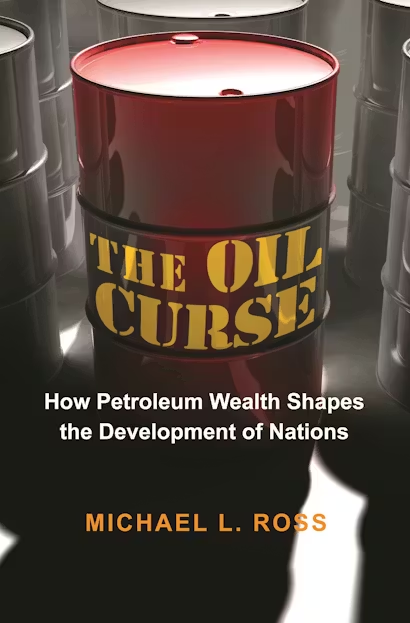
[6] The nationalizations and formation of national oil companies in the second half of the 20th century changed the distribution of bargaining leverage between host companies and extraction companies significantly. Host nations now capture much larger shares of the wealth generated by fossil fuel production, but that often doesn’t translate to better outcomes for the local populace. See Donald Ross’ excellent treatment of this issue, The Oil Curse.
[7] The energy transition playlist elsewhere on this website includes the song, “Do You Want My Job,” which addresses (poignantly) the power that wealthier societies have to offshore the dirtiest parts of their energy value chains.