I haven’t been on online platforms for a while because I am not very good at using them to disseminate my views. But I am here now because of something that should be of interest to the students and faculty everywhere. So, I hope my academic friends will see fit to share this with their followers (since I have relatively few of my own), even if they disagree with parts of it.
What triggered me was a recent Op-Ed in the Wall Street Journal by a University of Texas colleague attacking some Environmental Law Institute’s (ELI) educational programs in which I am involved. The Op-Ed insinuated that the ELI’s educational exchanges with Chinese scholars were a kind of fraternization with a geopolitical enemy that, along with ELI’s educational programs for judges, were designed to “punish” and “ruin” American energy firms, and to influence the outcome of climate litigation against fossil fuel firms in U.S. courts.
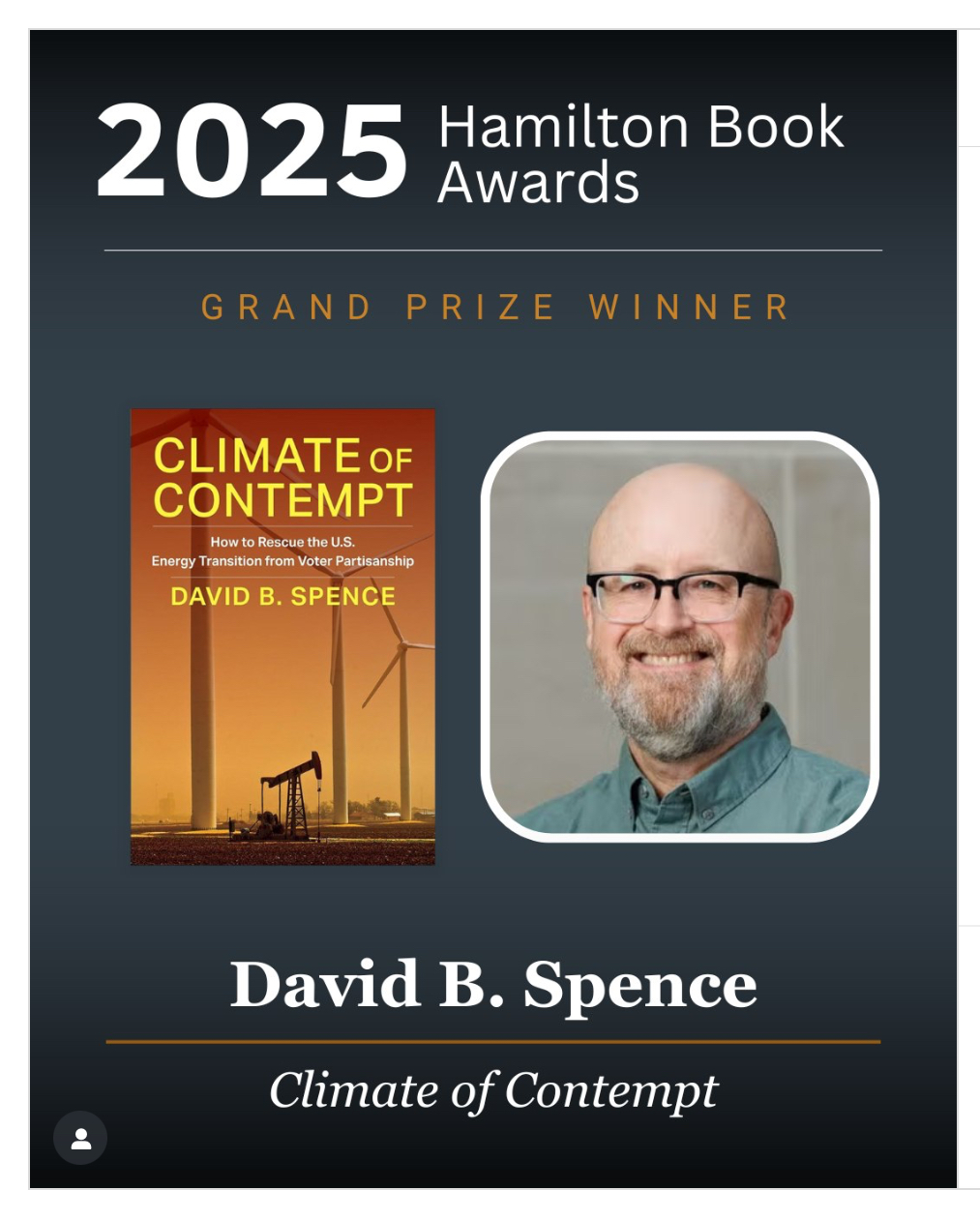
The fraternization criticism is silly on its face; UT and other universities engage in the same sorts of educational exchanges with Chinese scholars and officials all the time. The other claim, about ELI’s “Climate Judiciary Project,” is easily refuted by looking at ELI’s curriculum materials (which are available online), and by the fact that ELI recruited me to be a part of that project. I expressed doubt about both the ethical and legal basis for holding oil companies liable for damage done by pollution emitted by their customers in my 2024 book on U.S. energy law and politics (see p. 199).
That ought to be enough said. But the WSJ piece is so full of hyperbole, hypocrisy, and sloppy logic that it deserves a more detailed response, which I provide below. However, it also struck me as symptomatic of the ways ideological polarization is crowding academic freedom and scholarly rigor these days. And students should be aware of these forces. So, before rebutting this WSJ critique from the right, let me offer a brief review for students (and faculty who missed it) of this summer’s salty debate about threats to academic freedom from the left.
The Vanderbilt Report Debate
Debates over what right wing critics and the popular press describes as “wokism” in academia heated up this summer in reaction to a “Report on the State of Scholarship in the Humanities and Humanistic Social Sciences,” issued earlier this year by a group of scholars convened by Vanderbilt University’s president. The Report begins by emphasizing “the value of the humanistic disciplines and their central place in the modern research university” and stressing that “at their best, the humanities and the social sciences are as rigorous and as fruitful as they have ever been.” But its authors conclude that “[e]very field we have studied shows some signs of … deterioration in scholarly standards fueled by the substitution of political criteria for properly scholarly criteria in the assessment of research and a more general repudiation of long-standing ideals of rigor and objectivity” (my emphasis). The authors’ position is that truth-seeking and objectivity should always trump social justice advocacy in academic work, and more often than in the past does not.
Encouragingly, the debate in reaction to the Report has been thoughtful and nuanced, what one would expect of people whose job requires them to try to understand complex problems. Some defended the role of social justice advocacy in academic work by arguing that aspiring to objectivity is fruitless, and that the line between advocacy and truth-seeking is blurrier than the Vanderbilt Report suggests. Others shared the Report authors’ worries that social justice advocacy is eroding scholarly standards and displacing truth-seeking in scholarship and teaching. Much of this unfolded weekly throughout May, June and July in The Chronicle of Higher Education.
Some contributions to this discussion came from scholars within the disciplines the Vanderbilt Report criticized, and they told personal stories that supported the Report’s qualified critique. Examples included this interview in The Chronicle with a philosophy professor whose scholarship triggered the opprobrium of an online mob and her peers for challenging existing dogma within the discipline; and this Atlantic article from a disillusioned humanities scholar describing a university culture at Bates College that sounds like something out of the TV show Portlandia. But there were also stories of resistance to social pressure and certainty in service of the truth. One was an article in The Chronicle of Higher Education by a social psychology professor whose journey from advocate to truth-seeker began with this epiphany: “My question stopped being ‘What is true here?’ and slid toward ‘How do I show that what I believe is true?’ … I was never an activist, but I knew which answer I was hoping for in my research, and that is all it takes.” Another example was a Substack post from a research sociologist describing a similar realization during his Ph.D studies.
I don’t know how representative these stories are, but I found them inspiring. Together they reaffirm the value of truth-seeking and the dangers of dogmatic certainty, and they belie the oversimplified and caricatured versions of academia we hear about from both left and right.
The Attack on ELI
Which brings me back to the WSJ attack on ELI. Its author is Michael Toth, Director of Research for the University of Texas’ Civitas Institute. I assume Michael is a person of ability and integrity, but his Op-Ed is indeed full of sloppy logic and hypocrisy.
Toth characterizes ELI’s educational exchanges with Chinese scholars as “strange” for a nonprofit that “is supposedly politically neutral and has received millions of dollars in federal grants.” He does not say why those things are in conflict. After Toth quotes ELI to the effect that its exchanges with Chinese scholars are “about sharing evidence-based best practices on environmental regulation, not advancing the interests of [China],” he writes “[y]et the organization’s China ties persist.” As if the latter point contradicts the former?
Toth notes that one of ELI’s funders (the Oak Foundation) also donates to climate initiatives in China. The implied point here seems to be that because China is the world’s top emitter of carbon, ELI and others ought to shun China. But despite its environmental misdeeds, China can rightly boast some clean energy accomplishments too. (See e.g., The Economist’s Special Report on that topic last year.) Should academics pretend otherwise? China has sent groups of government officials to UT for educational purposes in the past, and I am sure that scholarly exchanges continue into the future. For major research universities these exchanges are common. Is UT guilty by association too?
The Op-Ed characterizes ELI as an organization that seeks “to ruin American energy firms with litigation.” It is evident from the ELI web site that ELI does not use litigation to advance its objectives. It is not that kind of NGO. It is an educational and collaborative institution. It seeks to educate on environmental science and policy and to bring people together to advance environmental understanding.
Charges of left-bias in the Op-Ed follow the same guilt-by-association logic. Toth is troubled by the fact that ELI has a left-leaning donor, the Hewlett Foundation, and some of its curricular content was created “with input from” environmental activists. If the ideological bias of donors and other affiliates undermines the integrity of educational institutions like ELI, then the Civitas Institute has an integrity problem. The Institute and its affiliated School of Civic Leadership are the brainchild of Republican politicians and conservative donors who believe that UT has become a place where students are brainwashed by “Marxist professors.” (For a deeper dive into the Institute’s political origins and donors, click here, here, here, here, or here; or just ask your favorite AI assistant.)
Similarly, Toth cites a report by a group called “State Armor” in support of the charge of pro-China bias. But State Armor’s principals are conservative activists too. According to its web site, its “Chief National Initiatives Officer” is one of the founders of the Texas Public Policy Foundation (TPPF). Unlike ELI, TPPF is engaged in activist litigation in pursuit of its right wing policy priorities. And what of other judicial education programs that are supported by conservative donors, such as the one run by George Mason University for the last half-century? Whatever principles underly Toth’s critique of ELI’s Climate Judiciary Project apply at least as strongly to the GMU program. (See here, here, here, and here.)
It may be that this WSJ Op-Ed is intended to dovetail with congressional Republicans’ attempts to discredit the Climate Judiciary Project. Both seem most concerned with the possibility that increasing judges’ climate science literacy will bias those judges against defendants in climate litigation. At the core of that concern is the nascent field of “attribution science,” which Toth rightly characterizes as “controversial.” But take a look at the ELI module on attribution science; it does nothing more than describe a complex reality that judges are already confronting in court. It notes that attributing harm to particular companies is fraught with doubt, and that many observers are (like me) reluctant to impose liability on fossil fuel extraction firms for emissions caused by the use of their products by others.
As perhaps the only UT faculty member participating in ELI programs, I asked WSJ editors they would consider publishing a rebuttal to Toth. The answer was “no.” Whether their motives were ideological or not is difficult to say. To be fair, the online future of “news” does not belong to the messy, complicated middle, but rather to the provocative and grabby extremes.
The Takeaways
In the Internet age it is increasingly difficult for students and faculty to resist the centrifugal forces pushing us onto one ideological team or the other. But the educational mission is about understanding the whole truth. The whole truth often comes with caveats, moral ambiguity, and shades of gray, but politics prefers simplicity and moral clarity. Students and professors alike need to work hard to hold onto that complexity and to resist orthodoxies and dogmas that get in the way of searching for (or even acknowledging) the whole truth.
That work is getting harder and harder, and unfortunately the online world is where these issues get discussed and resolved. I stopped posting here because that world isn’t kind to complicated truths. But maybe it can be in this instance.