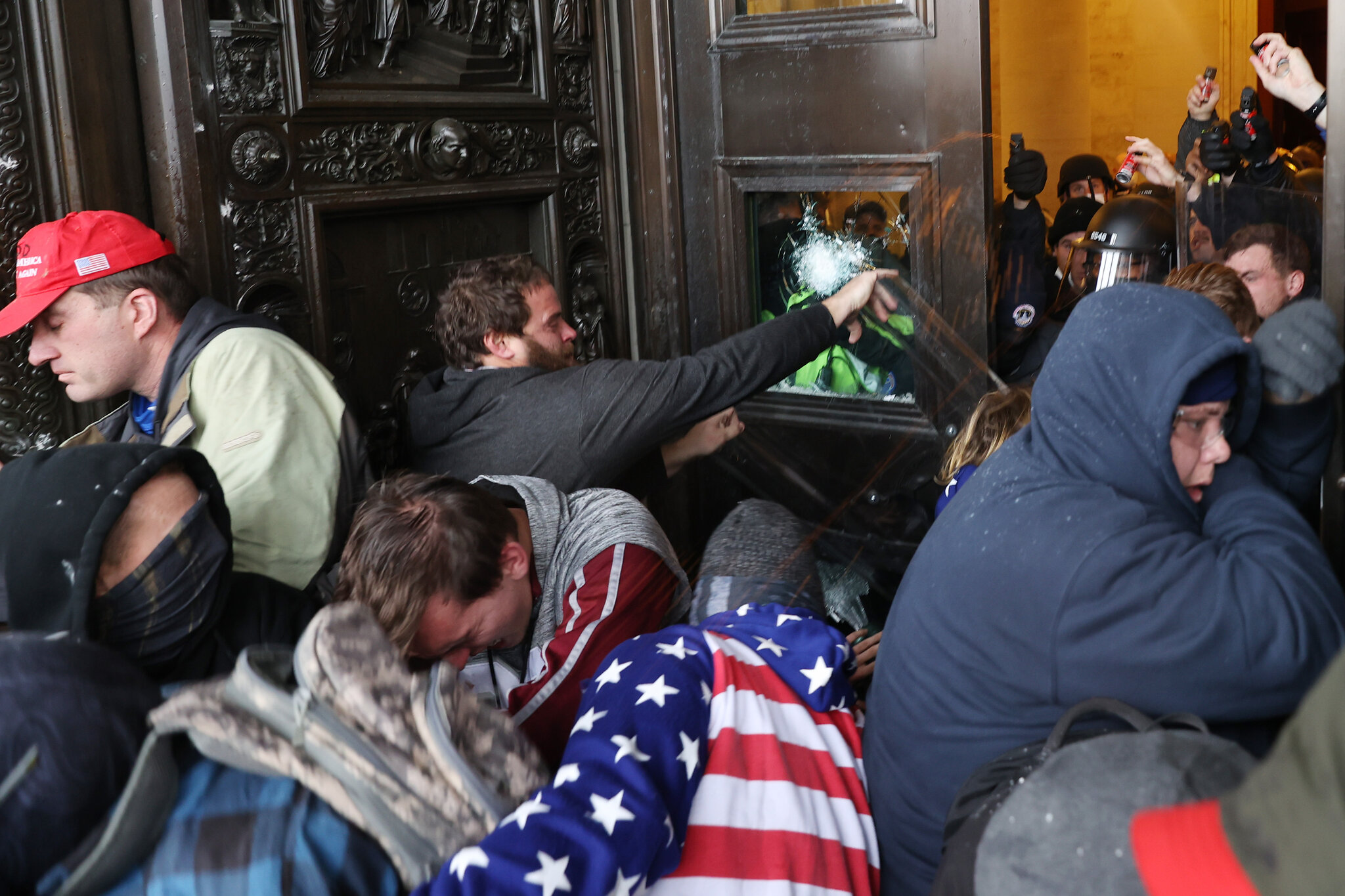
Last year Republicans in Congress tripled the Immigration and Customs Enforcement (ICE) budget, and the agency is establishing a permanent presence (renting offices, etc.) in communities all over the country. The rapid doubling of the number of ICE agents has created an armed force under presidential control that looks more like a weapon of political intimidation than a law enforcement agency. Its reckless lawlessness, coupled with the president’s remarks about “taking over” elections, has commentators talking more about political violence.
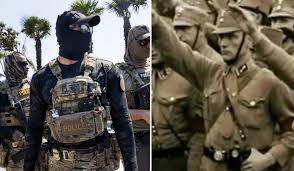
It seems less hyperbolic to liken ICE to the violent “brown shirts” of Nazi Germany, at least in so far as both groups seem unconstrained by the longstanding professionalism norms that we cultivate in our police and military academies. (See here, here, here, and for a lighter take, here.) Writing in the Bulwark earlier this month, Jonathan V. Last laid out the case for and against liberals “arming themselves.” And chess champion-turned-activist Garry Kasparov, who has personal experience living under dictatorship, reacted to the growth of ICE this way:
[I]f you think a massive US gulag is being built just for illegal immigrants, along with a federal paramilitary force as large as the Marines, you’re a fool. Billions in unaccountable cash from Venezuelan oil, shock troops, and detention camps. This is not a drill.
Escalating political violence in this country is grounded in Internet-amplified misinformation, which cultivates an increasingly intense partisan tribalism rooted in fear, anger and resentment — which in turn begets more violence.[1] And what people fear is rule by the other party.
Fear has non-violent effects too. We Democrats have tended to under-estimate the power of right wing propaganda to convince non-MAGA Republicans to go along with the MAGA agenda. Sophisticated propaganda [read: 24/7 ideological and social media] makes that agenda seem less frightening than Democratic Party rule. And until go-along Republican voters stop going along, we cannot expect go-along Republicans in Congress to stop going along. I contend that this is the most important dynamic driving violence:
[T]his trend of ever-increasing polarization and tribalism [must] be broken. If it continues to escalate, it risks the kind of periodic, identity-based political violence we associate with the sectarian conflicts of Northern Ireland and Israel/Palestine. A similar kind of unrest bubbled in the United States before the Civil War as well. Only voters can change this dynamic peacefully.[2]
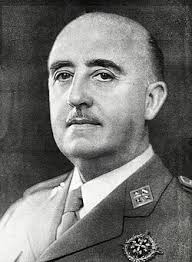
Were I writing this passage today I’d replace the U.S. Civil War with the Spanish Civil War. The former had clear geographic battle lines, North vs. South. The latter was just as brutal but much messier tactically. Like today’s inter-partisan hatred in the U.S., the battle lines were ideological rather than geographic. The Spanish Civil War pitted “nationalists” (read: fascists and their conservative allies) against “republicans” and their communist and anarchist allies. The rebel nationalists were driven by fears that that government was a stepping stone to communism. (Sound familiar?)
Unlike today’s U.S., Spanish communists actually were a formal part of that republican government, and were funded (and sometimes directed) by the Soviet Union. (To right wing media, today’s Democratic Socialists are communists.) But like today’s Democrats, Spain’s republicans had trouble staying united. The independent way the Spanish communists and anarchists conducted their campaigns during the war left moderate proponents of a truly liberal republican democracy with no comfortable home. The conflict stretched on and on until a form of fascism (or at least, military dictatorship) prevailed.
The speed with which the second Trump Administration has destroyed liberal democratic norms – the rule of law, (see here and here), respect for empirical truth, prohibitions against use of public office to enrich oneself – has made comparisons to fascism more apt, however much they offend conservative activists. Godwin’s Law is dead, at least as a quick way to de-legitimize comparisons to Naziism in public debate.
So how do we stay hopeful?
First, some observers believe that go-along Republican voters will not go along with the party’s increasingly open attempts to “fix” the 2026 or 2028 elections. I’m not so sure, but the probability that a critical mass of GOP voters will stop going along seems higher if the party tries to fix elections via ICE intimidation, which is deeply unpopular. But if it is instead accomplished more subtly, by shutting down polling places in Democrat areas or removing citizens from the voter registration rolls — efforts already underway — they may very well continue to go along. (If you want to be inspired today, Google “students march to polling place.”)
Still, we can pin our hopes on the fact that Donald Trump (and Trump-whisperer Stephen Miller) will instinctively favor the strategy that most clearly expresses their contempt for their opponents. It is sad to hope for tactical missteps borne of their festering resentments, but Trump/Miller may well overplay their hands.
Second, the rest of us can help the go-along Republican voters that we know to counteract their fears of the left: i.e., to recognize that most Democrats and anti-Trump Republicans are not the Marxist, gun-hating, religion-hating, moral scolds that they are constantly told we are. In the context of climate policy, that means (i) listening to the concerns of go-along Republicans about energy affordability, losing access to gasoline-powered cars or natural gas stoves, etc., (ii) taking those concerns seriously (i.e., resisting the temptation to dismiss them as fictitious, or mere “Republican talking points”), and (iii) trying to find common ground on climate.
That second point includes a corollary: every time opponents of the MAGA agenda paint with too broad a brush, expressing contempt for entire groups of people on the political right, we make our task of building winning coalitions more difficult by alienating potentially persuadable voters. And unless the left expects to win a shooting civil war with the right, it must use votes and the law — to the extent the courts are willing to enforce it — to win political power.
Those are, in my opinion, the political paths in which we can place our hope. Fortunately, there are organizations and people putting those strategies into practice. We are counting on them to reduce contempt and violence in our politics. — David Spence
—————————-
[1] See Climate of Contempt pp. 18 (the sense that my “party’s victory is necessary to protect basic American values and a cherished way of life … is provoking an upturn in political violence”), p. 121 (quoting elected GOP officials advocating violence), p. 124 (describing how and why recent political violence, and increased voter support for political violence, is bipartisan), p. 247 (n. 63)(describing ambivalence about liberal democracy among student members of the Federalist Society).
[2] Climate of Contempt, p. 232.