[Previous posts in this series: #1 / #2 / #3]
Many people are familiar with this Will Rogers quote: “I don’t belong to any organized political party. I am a Democrat.” Democrats have always understood that they are a big tent ideologically; and given today’s go-along-with-MAGA GOP, Democrats have the only tent welcoming those with energy transition ambitions. But do Democrats understand one another?
What do the data say about who Democrats are and what they believe?
In our balkanized information ecosystems, intraparty divides among policy elites are sometimes far more heated than many voters’ realize. For example, the recent death of neo-Malthusian biologist Paul Ehrlich unleashed outright celebratory posts online among moderate environmentalists in language and tone worthy of Donald Trump. (Here is one illustrative example, for those unfamiliar with this dispute.) That kind of hyperbolic reaction, in turn, can be seen as a response to years of progressives’ charges that moderate environmentalists and techno-optimists are indifferent to environmental and climate harms. And many Democrats are blissfully unaware of these divides.
Pluralistic Ignorance
My academic colleague Mike Vandenbergh studies the extent to which Republicans misunderstand one another – so-called “pluralistic ignorance” within an ideological group. He finds, for example, that Republicans often underestimate the degree to which their co-partisans worry about climate change. But of course, in-group pluralistic ignorance afflicts Democrats too.
One way in which pluralistic ignorance manifests on the left is in “no true Scotsman” denials that some of the more extreme left rhetoric and positions are significant enough to alienate traditional Democrat constituencies from the Democratic Party. The denial goes like this. “The right amplifies unpopular ideas from a tiny fringe left. No true Democrat wants to take away our guns, abolish capitalism, open our borders, replace biological sex with gender identity, take away our gas stoves and gasoline-powered cars, etc.”
But some Democrats do want those things. It may be numerically accurate to call them a relatively small minority; but if you have never been part of a left-leaning political discussion on Twitter/X, BlueSky, or parts of academia, one cannot deny their existence or prominence in the public debate. Indeed, they are part of the Democratic coalition, and silencing or dismissing them is not the answer. But how they make their case matters politically, and it has done damage to Democrats’ fortunes in places.[2] For example, political scientists Suzanne Mettler and Trevor Brown’s recent book-length empirical evaluation of our urban-rural partisan divide includes a chapter entitled, “Overbearing Elites and Rural Resentment.” And theirs is only the latest in a long line of studies, some of which I have discussed previously in this space, crediting “liberal elites” with pushing rural voters toward the GOP.
Modern ideological and social media enable right wing media to provide voters with a 24/7 push toward the conclusion that the most insensitive, scolding elites are what “Democrats” are. Even never-Trump conservatives who yearn for a stronger opposition to Trumpism, like American Enterprise Institute’s Ruy Texeira, tend to conflate “progressives” and “Democrats.” That GOP conflation strategy has worked particularly well when applied to culture war issues (see here and here). Which is why the GOP has tried to characterize Democrats’ climate policy in culture war terms, as “woke capitalism.” Consequently, GOP support for expanding clean energy is plummeting.
Some progressive advocates conceive of their ideas as moral imperatives, which makes working with political allies to alter their messaging approach more difficult. But creating a stronger climate policy is not actually a “good vs. evil morality play”; it is a practical political challenge. In a democracy, that means building a durable congressional majority. The good news is that ambitious climate policy still commands a popular majority, but it is thwarted by MAGA voters’ control of the electoral futures of GOP politicians. Changing that means changing the behavior of non-MAGA Republicans.
So, it would behoove those of us in the climate coalition to be clear-eyed, precise, and transparent about our intraparty disagreements and how they affect the swing votes. Data can help.
Polling & the Progressive-Moderate “Divide”
Gallup polling tells us that, ideologically, both parties have gotten much more ideologically extreme over time, alienating moderates – who then exit the parties and come to identify as independents. This further exacerbates the unrepresentativeness of primary voters who exercise outsized influence in choosing congressional representatives.
Pew Research polling tells us that 79% of Democrats identify as left of center, and another 13% as apolitical “stressed sideliners.” The breakdown of that 79% is as follows: 12% progressive, 23% establishment liberals, 28% “Democratic mainstays,” and 16% “outsider left.”[3]
Looking at the larger electorate, a polling group called “More in Common” tells us that fully 41% of the electorate is either “politically disengaged” (26%) or “moderate” (15%), and another 34% sit to the left of center. That 34% consists of progressives (8%), traditional liberals (11%) or “passive liberals” (15%).
Yale’s Climate Poll tells us that when it comes to climate policy, a majority of the public are either alarmed (26%) or concerned (28%), and another 18% feel “cautious” about climate change.
These data help us see beyond our own bubbles, and better illuminate the progressive-moderate divide among Democrats.
Observation #1: As noted above, climate change is not just a progressive issue. Democrats and moderates worry about it as well. (Nor is it something congressional Democrats neglected prior to the 2018 blue wave election.) A large percentage of voters — presumably a huge percentage of Democrats — support policies addressing climate change. Which means that elected Republicans who are busy trying to kneecap renewable energy projects (see e.g., here and here) and weaken regulation of greenhouse gas emissions (see here) are out of step with the voters. Unfortunately, they are in step with the mostly MAGA primary voters in their party who control their electoral futures.
Observation #2: The ideological divide between right and left is stark, but Democrats agree with each other on most policy goals. Nevertheless, those on the right and left poles get most of the attention, and drive negative partisanship. In the words of More in Common: “Devoted Conservatives have the warmest sentiments towards Trump supporters and NRA members, and the coldest sentiments towards Black Lives Matter activists and Hillary Clinton supporters. Progressive Activists have the warmest feelings towards LGBTQI+ people and refugees, and the coldest feelings towards Trump supporters and NRA members. The feelings of Progressive Activists towards Trump supporters were the coldest recorded for any group.”
Observation #3: Progressives are demographically different. Within the Democratic coalition, the 12% who identify as progressive are the most politically active, the most “white,” the youngest, and the only subgroup that says they favor candidates who identify as democratic socialists.
Observation #4: Progressives are correct when they say that the “outsider left” agrees with them on the issues, though together the two groups constitute only 28% of Democrats. In places where the outsider or nonpartisan left constitutes a large percentage of the electorate — places like Maine — that coalition might produce a victory in November. But generally, where the views of the outsider left/progressive coalition differ from those of other Democrats, their positions are more out of step with the electorate as a whole.
The first figure below (click to enlarge) shows the Pew Research data, delineating the percentage of each group in the Pew typology that agrees with each issue statement, with a special focus on the left. The second figure (click to enlarge) below is from the More In Common report. Both figures are worth studying.
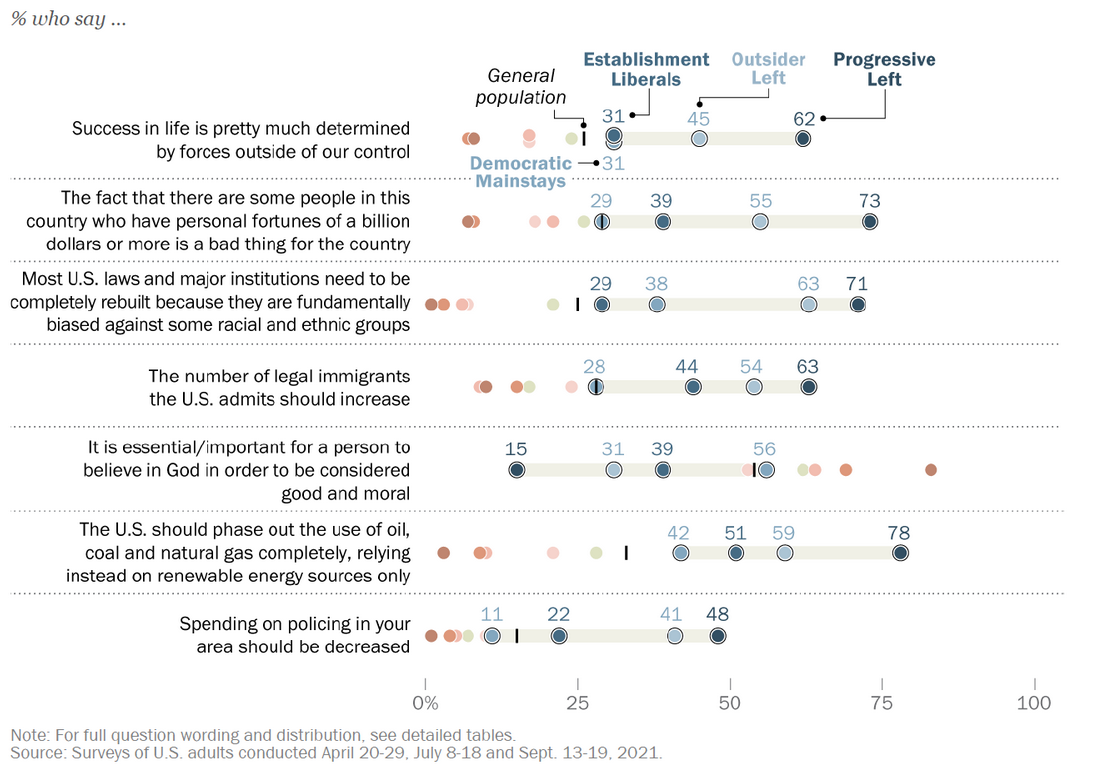
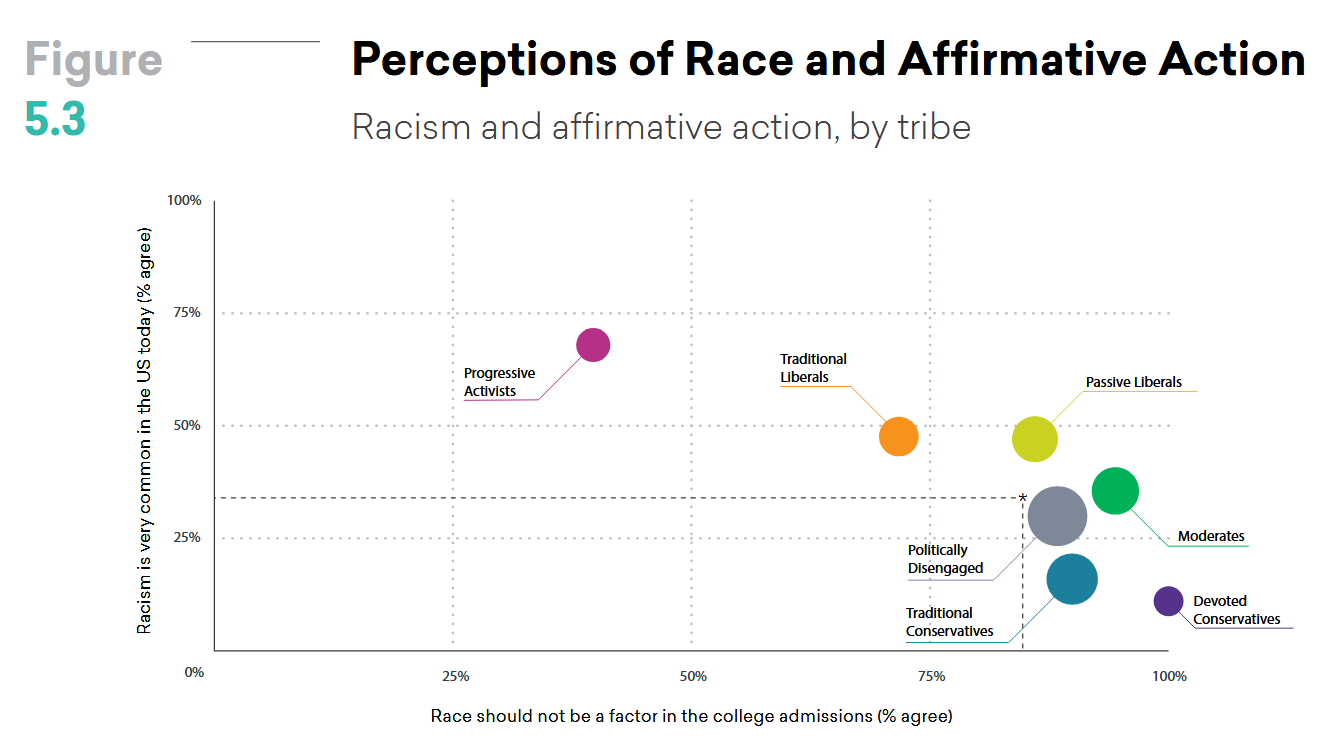
If Democrats’ goal is to win more elections in the near term, it strains credulity to look at these data and conclude that Democrats’ must merely wake up the unwoke, or mobilize first time voters. This is not 1933. There is nothing in the empirical data to suggest that the persuadable voters are mostly (and latently) progressive.
Furthermore, we in the climate coalition hurt our cause when we accept the GOP’s pairing of the energy transition with cultural morality. The energy transition is an economic policy goal, one replete with difficult tradeoffs that voters worry about. They still broadly support the objective, but it is one more likely to be achieved by acknowledging voters’ worries about affordability and reliability rather than dismissing them as “Republican talking points.” Democrats of all stripes want to reduce emissions if it can be done without jeopardizing those other values. And since it can, why not acknowledge these tradeoffs while pursuing a cleaner energy mix? De-emphasizing them only breeds suspicion.
In the 2026 electoral cycle Democrats are indeed focusing on “affordability”; if that approach yields electoral change that lasts more than one or two electoral cycles, perhaps we can get the energy transition on a faster track.
Conclusion
Even though my book levels some of the same criticisms at neo-Malthusian environmentalism featured in the spate of recent anti-eulogies of Paul Ehrlich, the nastiness of those reactions shocked me. Neither techno-optimists nor neo-Malthusians are evil. They are people who disagree about how to address important environmental problems. When Democrats ascribe evil intent to one another we undermine progress toward a cleaner energy future.
The Internet helps use make this mistake by insulating us inside information/social bubbles that cultivate these judgy moralizing narratives very efficiently. Those narratives can be undone by repeated exposure to real people from outside the bubble. That takes effort, but the effort is worth it. — David Spence
NEXT POST: Structural fixes
———–
[1] Chapter 4 of Climate of Contempt contains many examples, and summarizes the academic literatures that explain this phenomenon.
[2] For Democrats who are entirely offline, the “no true Scotsman” dismissal is particularly appealing. But hyperbolic rhetoric and extremism thrives in bubbles, even on platforms with relatively elevated discussion. Blithe dismissals of opposing views as ignorant or ill-conceived can be profane on one platform and erudite on another. Both are often too judgmental and not curious enough.
[3] Note that an April 2026 Economist analysis (behind a paywall) voters estimates that progressives constitute a much larger share of the Democratic voting bloc (40%). The disparity from Pew estimates may reflect a broader definition of “progressive” that encompasses most voters with liberal views on social and cultural issues. Or it may be that the progressive bloc has swollen during Trump 2.0.